
PAD2- and PAD4-modified PhIP-Seq libraries resolve per-epitope, per-isoform ACPA fingerprints across the human proteome — matching the clinical CCP test at 90–95% sensitivity and 100% specificity.
EBioMedicine · September 2021 · DOI: 10.1016/j.ebiom.2021.103506
Román-Meléndez GD, Monaco DR, Montagne JM, et al. Citrullination of a phage-displayed human peptidome library reveals the fine specificities of rheumatoid arthritis-associated autoantibodies. EBioMedicine. 2021;71:103506. doi:10.1016/j.ebiom.2021.103506
Román-Meléndez, G. D., Monaco, D. R., Montagne, J. M., Quizon, R. S., Konig, M. F., Astatke, M., Darrah, E., & Larman, H. B. (2021). Citrullination of a phage-displayed human peptidome library reveals the fine specificities of rheumatoid arthritis-associated autoantibodies. EBioMedicine, 71, 103506. https://doi.org/10.1016/j.ebiom.2021.103506
@article{romanmelendez2021citrullination,
  author  = {Rom{\'a}n-Mel{\'e}ndez, Gabriel D. and Monaco, Daniel R. and Montagne, Janelle M. and Quizon, Rachel S. and Konig, Maximilian F. and Astatke, Mekbib and Darrah, Erika and Larman, H. Benjamin},
  title   = {Citrullination of a phage-displayed human peptidome library reveals the fine specificities of rheumatoid arthritis-associated autoantibodies},
  journal = {EBioMedicine},
  volume  = {71},
  pages   = {103506},
  year    = {2021},
  doi     = {10.1016/j.ebiom.2021.103506}
}
Román-Meléndez and colleagues adapted Phage ImmunoPrecipitation Sequencing (PhIP-Seq) to the quantitative analysis of antibody reactivity against an enzymatically citrullinated human peptidome library, enabling proteome-scale, epitope-resolved characterization of anti-citrullinated protein antibody (ACPA) responses in rheumatoid arthritis. Comparing PAD2- and PAD4-modified versions of a ~250,000-peptide 90-mer library against unmodified counterparts, the assay distinguished citrulline-dependent autoreactivities and resolved PAD-isoform-specific ACPA fingerprints in individual patients — moving the RA serology biomarker from pan-CCP positivity to per-epitope, per-PAD-isoform resolution.
In this publication:
Rheumatoid arthritis (RA) is associated with autoantibodies that recognize citrullinated proteins — proteins in which the amino acid arginine has been enzymatically converted to citrulline by peptidylarginine deiminase (PAD) enzymes. The clinical anti-cyclic citrullinated peptide (CCP) test is highly informative for RA diagnosis but reports a single global readout: it doesn’t tell clinicians which citrullinated targets a given patient’s antibodies actually recognize, nor whether those antibodies prefer PAD2- or PAD4-citrullinated substrates.
The authors adapted Phage ImmunoPrecipitation Sequencing (PhIP-Seq) — a programmable phage-display platform that displays ~250,000 overlapping 90-amino-acid peptide tiles spanning the human proteome — to this problem. They enzymatically citrullinated the library in vitro using recombinant human PAD2 and PAD4 enzymes, established quality-control criteria for the modification, and then mixed each modified library, alongside its unmodified counterpart, with patient serum. Antibody-bound phage clones are immunoprecipitated, PCR-amplified, and quantified by deep DNA sequencing. By comparing read counts between modified and unmodified libraries, peptides whose binding depended on citrullination — the citrulline-specific ACPA targets — could be identified epitope-by-epitope, across the proteome, in an unbiased way.
Applied to a cohort of 31 RA patients and 10 demographically matched healthy controls, the assay was highly concordant with clinical anti-CCP serostatus and resolved PAD-isoform-specific ACPA reactivity profiles among individual patients. The authors propose PAD PhIP-Seq as a powerful, quantitative tool for proteome-scale antibody-binding analyses in RA and, by extension, as a generalizable framework for studying autoantibodies against any post-translationally modified epitope — carbamylation, acetylation, phosphorylation, and others — opening a path to longitudinal monitoring of pre-clinical RA, response to PAD-targeted therapeutics, and novel PTM-associated autoantigen discovery.

HuSIGHT + EnviroSIGHT for Parkinson's research: environmental triggers and autoimmune contributions in one assay.
Read more
Proteome-wide assessment of therapeutic candidate antibodies: comprehensive profiling of on- and off-target binding with…
Read more
A single unbiased screen against the human proteome recovers the established SLE autoantibody suite and surfaces novel c…
Read more
The molecular record of every infection, exposure, and immune response the body has generated over a lifetime.
Read more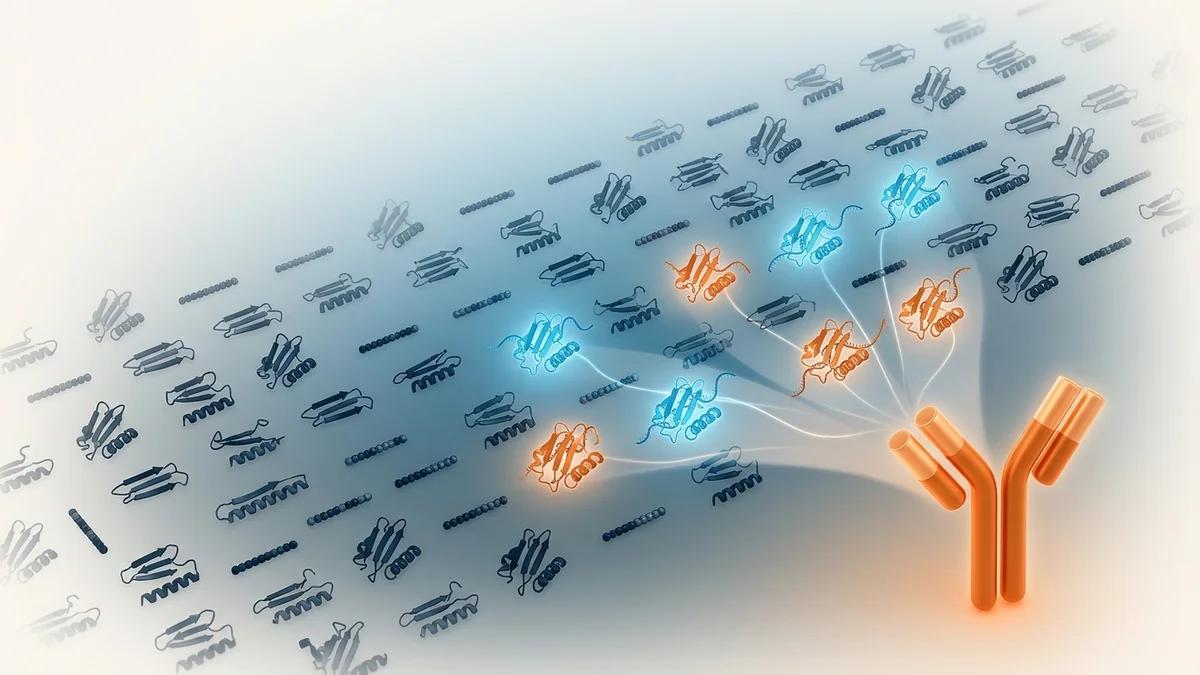
A single unbiased screen across 368,000+ human protein and peptide targets recovers known SLE autoantigens and detects n…
Read more
Where the antibody reactome fits in the multi-omic stack, how MIPSA deciphers it, and what the HuSIGHT, VirSIGHT, and En…
Read more
Anti-Sp4 autoantibodies modify cancer risk in TIF1γ-positive dermatomyositis patients.
Read moreAnti-cavin-4 autoantibodies as a biomarker for immune-mediated rippling muscle disease.
Read moreCredle et al., Nature Comm 2022: the foundational MIPSA paper introducing antibody reactome profiling.
Read moreAuto-antibody reactivities against ubiquitously expressed antigens identified in viral myocarditis cohort.
Read moreBjornevik et al., Science 2022: 10M serial serum samples link EBV to multiple sclerosis.
Read moreTGM4: an immunogenic, prostate-restricted antigen and research target for prostate cancer.
Read more