
An unbiased proteome-wide screen converts a long-anonymous IBM autoantibody into the field's first widely adopted blood biomarker.
Annals of Neurology · March 2013 · DOI: 10.1002/ana.23840
Larman HB, Salajegheh M, Nazareno R, et al. Cytosolic 5'-nucleotidase 1A autoimmunity in sporadic inclusion body myositis. Ann Neurol. 2013;73(3):408-418. doi:10.1002/ana.23840
Larman, H. B., Salajegheh, M., Nazareno, R., Lam, T., Sauld, J., Steen, H., Kong, S. W., Pinkus, J. L., Amato, A. A., Elledge, S. J., & Greenberg, S. A. (2013). Cytosolic 5'-nucleotidase 1A autoimmunity in sporadic inclusion body myositis. Annals of Neurology, 73(3), 408–418. https://doi.org/10.1002/ana.23840
@article{larman2013cn1a,
  author  = {Larman, H. Benjamin and Salajegheh, Mohammad and Nazareno, Remedios and Lam, Theresa and Sauld, John and Steen, Hanno and Kong, Sek Won and Pinkus, Jack L. and Amato, Anthony A. and Elledge, Stephen J. and Greenberg, Steven A.},
  title   = {Cytosolic 5'-nucleotidase 1A autoimmunity in sporadic inclusion body myositis},
  journal = {Annals of Neurology},
  volume  = {73},
  number  = {3},
  pages   = {408--418},
  year    = {2013},
  doi     = {10.1002/ana.23840}
}
This paper identifies cytosolic 5'-nucleotidase 1A (cN1A; NT5C1A) as the molecular target of a circulating 43 kDa autoantibody in sporadic inclusion body myositis (IBM). Two complementary unbiased approaches — mass spectrometry on antibody-enriched muscle preparations and screening of patient antibodies against a 413,611-peptide synthetic human peptidome — converged on the same target. Diagnostic testing in 200 plasma and serum samples established anti-cN1A as the first widely adopted serum biomarker for IBM, with 70% sensitivity and 92% specificity at moderate reactivity, and immunohistochemistry localized the target to the rimmed vacuoles that define IBM pathology.
In this publication:
The team applied two complementary unbiased approaches to a long-recognized but molecularly anonymous IBM autoantibody: mass spectrometry on muscle protein preparations enriched by IBM patient antibodies, and screening of IBM patient antibodies against a synthetic human peptidome covering essentially the entire human proteome. Both converged independently on cN1A.
Diagnostic test performance against 200 plasma and serum samples placed anti-cN1A at 70% sensitivity and 92% specificity for IBM at moderate reactivity, and 34% sensitivity at 98% specificity at high reactivity. Immunohistochemistry on 30 muscle biopsies localized cN1A reactivity to perinuclear regions and rimmed vacuoles — the same anatomical structures associated with IBM's degenerative pathology — providing tissue-level evidence that the autoimmune target colocalizes with the histopathological hallmarks.
The work reframes sporadic inclusion body myositis as a disease with a definable autoantibody-defined immune component, not a purely degenerative myopathy, and provides a mechanistic link between IBM's autoimmune and myodegenerative processes — a major nosological clarification for a disease historically classified at the boundary of these two categories. For autoantigen discovery programs working in under-served neuromuscular and rare autoimmune diseases, the study is a methodological template demonstrating how an unbiased screen against a proteome-spanning peptide library can convert a clinically suggestive but molecularly uncharacterized antibody reactivity into a fully defined autoantigen, immunodominant epitope map, and diagnostic test in a single integrated workflow.

HuSIGHT + EnviroSIGHT for Parkinson's research: environmental triggers and autoimmune contributions in one assay.
Read more
Proteome-wide assessment of therapeutic candidate antibodies: comprehensive profiling of on- and off-target binding with…
Read more
A single unbiased screen against the human proteome recovers the established SLE autoantibody suite and surfaces novel c…
Read more
The molecular record of every infection, exposure, and immune response the body has generated over a lifetime.
Read more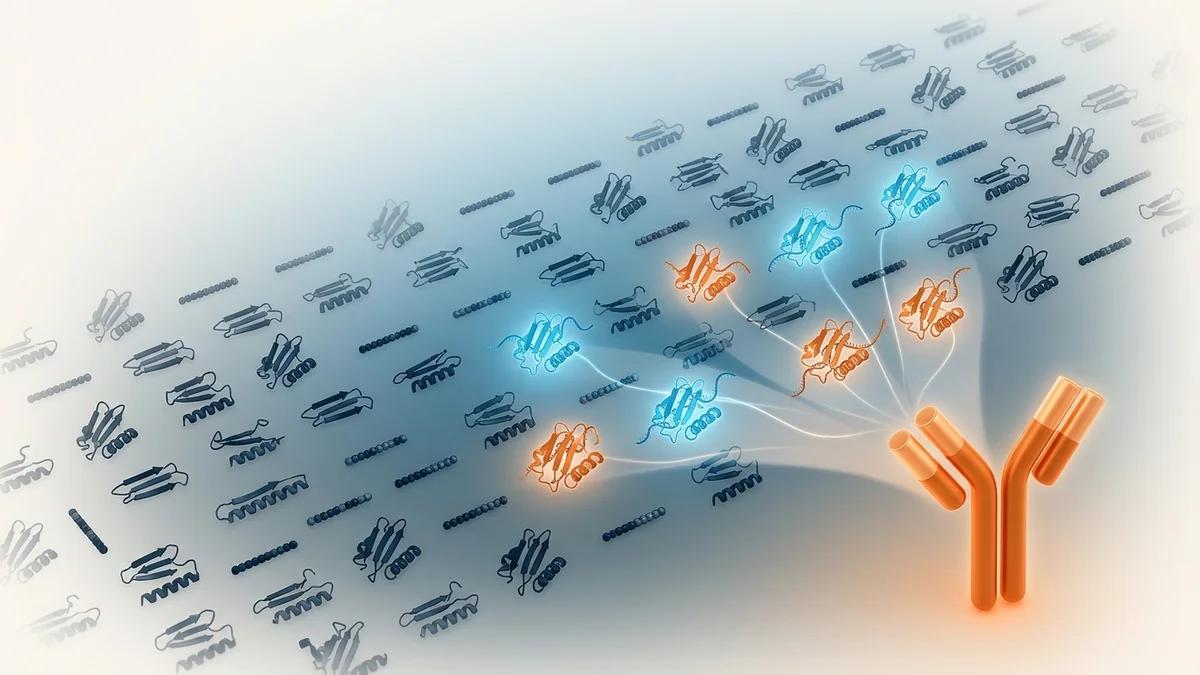
A single unbiased screen across 368,000+ human protein and peptide targets recovers known SLE autoantigens and detects n…
Read more
Where the antibody reactome fits in the multi-omic stack, how MIPSA deciphers it, and what the HuSIGHT, VirSIGHT, and En…
Read more
Anti-Sp4 autoantibodies modify cancer risk in TIF1γ-positive dermatomyositis patients.
Read moreAnti-cavin-4 autoantibodies as a biomarker for immune-mediated rippling muscle disease.
Read moreCredle et al., Nature Comm 2022: the foundational MIPSA paper introducing antibody reactome profiling.
Read moreAuto-antibody reactivities against ubiquitously expressed antigens identified in viral myocarditis cohort.
Read moreBjornevik et al., Science 2022: 10M serial serum samples link EBV to multiple sclerosis.
Read moreMapping anti-citrullinated protein antibody specificities in rheumatoid arthritis at single-epitope resolution.
Read more