
Two opposing pre-infection envelope epitopes track with later viremic control versus risk — reframing humoral immunity in HIV outcome.
Frontiers in Immunology · September 2023 · DOI: 10.3389/fimmu.2023.1178520
Grant-McAuley W, Morgenlander W, Hudelson SE, et al. Comprehensive profiling of pre-infection antibodies identifies HIV targets associated with viremic control and viral load. Front Immunol. 2023;14:1178520. doi:10.3389/fimmu.2023.1178520
Grant-McAuley, W., Morgenlander, W., Hudelson, S. E., Thakar, M., Piwowar-Manning, E., Clarke, W., Breaud, A., Blankson, J., Wilson, E., Ayles, H., Bock, P., Moore, A., Kosloff, B., Shanaube, K., Meehan, S.-A., van Deventer, A., Fidler, S., Hayes, R., Ruczinski, I., Kammers, K., Laeyendecker, O., Larman, H. B., & Eshleman, S. H. (2023). Comprehensive profiling of pre-infection antibodies identifies HIV targets associated with viremic control and viral load. Frontiers in Immunology, 14, 1178520. https://doi.org/10.3389/fimmu.2023.1178520
@article{GrantMcAuley2023preinfection,
  title   = {Comprehensive profiling of pre-infection antibodies identifies HIV targets associated with viremic control and viral load},
  author  = {Grant-McAuley, Wendy and Morgenlander, William and Hudelson, Sarah E. and Thakar, Manjusha and Piwowar-Manning, Estelle and Clarke, William and Breaud, Autumn and Blankson, Joel and Wilson, Ethan and Ayles, Helen and Bock, Peter and Moore, Ayana and Kosloff, Barry and Shanaube, Kwame and Meehan, Sue-Ann and van Deventer, Anneen and Fidler, Sarah and Hayes, Richard and Ruczinski, Ingo and Kammers, Kai and Laeyendecker, Oliver and Larman, H. Benjamin and Eshleman, Susan H.},
  journal = {Frontiers in Immunology},
  volume  = {14},
  pages   = {1178520},
  year    = {2023},
  doi     = {10.3389/fimmu.2023.1178520}
}
Using massively multiplexed VirScan antibody profiling on 664 longitudinal samples from the HPTN 071 (PopART) community-randomized HIV prevention trial, the authors identified two pre-infection HIV envelope epitopes whose antibody reactivity tracks in opposite directions with later viremic control. Pre-infection antibody binding to an HR2 epitope on gp41 was associated with becoming an HIV controller and lower set-point viral load, while pre-infection reactivity to a C2 epitope on gp120 was associated with non-controller status and higher viral load. The findings point toward humoral mechanisms that modulate set-point viremia and toward potential antibody-based intervention targets for prevention and treatment.
In this publication:
People who become infected with HIV settle into very different "set-point" viral loads, and a small minority — HIV controllers — keep the virus suppressed without antiretroviral treatment. The mechanisms that determine who controls and who does not are still incompletely understood, and the role of antibodies that exist before infection has been particularly hard to study at scale.
This work, led by Wendy Grant-McAuley and Susan Eshleman at Johns Hopkins University School of Medicine in collaboration with the HPTN 071 (PopART) study team, applied a massively multiplexed phage-display antibody profiling system (VirScan) to longitudinal samples from a community-randomized HIV prevention trial of more than 48,000 participants in Zambia and South Africa. The team analyzed 664 samples from 429 participants — 13 controllers, 135 viremic non-controllers, 64 other non-controllers, and 217 HIV-uninfected persons — and quantified antibody reactivity against the entire HIV peptidome both before and after infection.
Two pre-infection envelope epitopes stood out. Antibody binding to a region in the HR2 domain of gp41 (the "C epitope") was much more common before infection in people who later became controllers (23.1%) than in people who later became viremic non-controllers (3.7%), and pre-infection reactivity to this epitope was associated with significantly lower post-infection viral loads. The HR2 region is critical for the membrane fusion step of HIV entry, and antibodies targeting it have been described in slow progressors and elite controllers — consistent with a model in which pre-existing C-epitope antibodies suppress viral replication. In contrast, pre-infection reactivity to a C2 epitope on gp120 was found in viremic non-controllers and absent in controllers, and tracked with higher post-infection viral loads, possibly reflecting antibody-dependent enhancement of infection. The two epitopes also showed distinct longitudinal trajectories after infection. Together, the findings suggest that pre-infection humoral immunity to specific HIV envelope sites helps shape the eventual set-point viral load and could inform antibody-based prevention and treatment strategies.

A peer-reviewed methodology white paper for VirSIGHT, Infinity Bio's unbiased antibody reactome assay covering 500+ huma…
Read more
VirSIGHT at a glance: antibody reactome profiling across the known human virome (500+ species).
Read more
The molecular record of every infection, exposure, and immune response the body has generated over a lifetime.
Read more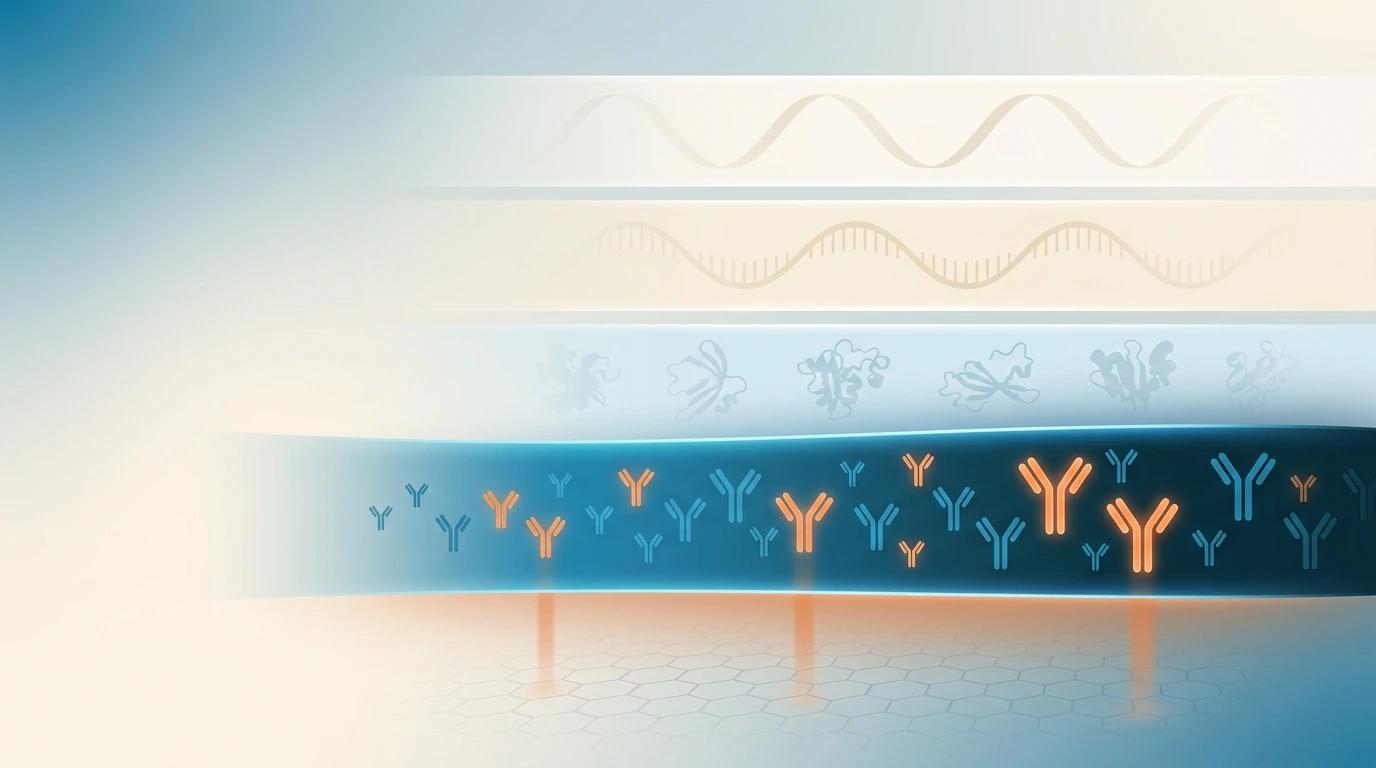
Where the antibody reactome fits in the multi-omic stack, how MIPSA deciphers it, and what the HuSIGHT, VirSIGHT, and En…
Read more
Lindahl et al., 2026: viral immunity in IgG products and global immunity debt.
Read moreAntibody reactome profiling of bat reservoirs identifies emerging zoonotic potential for biosurveillance.
Read moreAntibody reactome profiling of the human anellome: small DNA viruses persisting in healthy hosts.
Read moreFemales develop broader vaccine-induced antibody repertoires, driven by germinal-center B-cell diversity.
Read moreBjornevik et al., Science 2022: 10M serial serum samples link EBV to multiple sclerosis.
Read moreAntibody epitope selection is partially heritable, shown across twin and SNP-genotyped cohorts.
Read moreBioinformatic deconvolution of cross-reactive signals in virome-wide antibody reactome data.
Read moreSARS-CoV-2 antibody signatures predict convalescent plasma antiviral function.
Read more