
AVARDA — a probabilistic deconvolution algorithm for VirScan PhIP-Seq — lifts viral encephalitis diagnosis by 44% and resolves species-level virus calls across cross-reactive epitopes.
EBioMedicine · December 16, 2021 · DOI: 10.1016/j.ebiom.2021.103747
Monaco DR, Kottapalli SV, Breitwieser FP, et al. Deconvoluting virome-wide antibody epitope reactivity profiles. EBioMedicine. 2022;75:103747. doi:10.1016/j.ebiom.2021.103747
Monaco, D. R., Kottapalli, S. V., Breitwieser, F. P., Anderson, D. E., Wijaya, L., Tan, K., Chia, W. N., Kammers, K., Caturegli, P., Waugh, K., Roederer, M., Petri, M., Goldman, D. W., Rewers, M., Wang, L.-F., & Larman, H. B. (2022). Deconvoluting virome-wide antibody epitope reactivity profiles. EBioMedicine, 75, 103747. https://doi.org/10.1016/j.ebiom.2021.103747
@article{monaco2022avarda,
  author  = {Monaco, Daniel R. and Kottapalli, Sanjay V. and Breitwieser, Florian P. and Anderson, Danielle E. and Wijaya, Limin and Tan, Kevin and Chia, Wan Ni and Kammers, Kai and Caturegli, Patrizio and Waugh, Kathleen and Roederer, Mario and Petri, Michelle and Goldman, Daniel W. and Rewers, Marian and Wang, Lin-Fa and Larman, H. Benjamin},
  title   = {Deconvoluting virome-wide antibody epitope reactivity profiles},
  journal = {EBioMedicine},
  volume  = {75},
  pages   = {103747},
  year    = {2022},
  doi     = {10.1016/j.ebiom.2021.103747}
}
Monaco and colleagues introduce AVARDA (AntiViral Antibody Response Deconvolution Algorithm), a probabilistic software framework that resolves antibody cross-reactivity in VirScan PhIP-Seq data to species-level virus calls. By building a sequence-alignment graph across the library and assigning each binding event probabilistically among the candidate viruses that could explain it, AVARDA suppresses the “one shared motif inflates ten species” failure mode that confounded prior peptide-counting pipelines. Applied to encephalitis, type 1 diabetes, and systemic lupus erythematosus cohorts, AVARDA improved viral encephalitis diagnosis by 44% and surfaced enterovirus and herpesvirus signals associated with autoimmune disease — resetting the analytical floor for virome-wide serology.
In this publication:
VirScan is a programmable phage-display assay that displays roughly 100,000 short peptides spanning the entire human virome and then measures which of those peptides are bound by antibodies in a patient’s serum. The promise is breathtaking — one assay, one drop of blood, the cumulative record of viral exposure. The problem, until this paper, was that many of those peptides come from highly conserved regions shared across related viruses. A patient infected with herpes simplex virus 1 (HHV-1) might also score positive for cytomegalovirus (HHV-5) simply because their antibodies recognise a peptide motif both viruses carry. Earlier VirScan analytical pipelines counted hits without correcting for this cross-reactivity, and they did not adjust for the fact that some viruses are represented by far more peptides in the library than others.
AVARDA — the AntiViral Antibody Response Deconvolution Algorithm — addresses both gaps. It first builds a sequence-alignment graph that records every peptide-to-peptide and peptide-to-virus relationship in the library. It then assigns each observed binding event probabilistically across the candidate viruses that could explain it, and tests whether the cumulative evidence for any given virus exceeds what would be expected by chance. The output is a per-virus probability score and an effective-breadth measurement that resists the classic “one shared motif inflates ten species” failure mode — the same conceptual move that gave shotgun metagenomics species-level resolution a decade earlier.
The authors validated the approach on three cohorts. In a set of encephalitis patients with paired acute and convalescent sera, AVARDA correctly identified the responsible herpesvirus (HHV-1, HHV-3, HHV-4, HHV-5, or HHV-6) in cases that prior testing had either confirmed clinically or left undiagnosed — yielding a 44% improvement in viral encephalitis diagnosis. Applied to a type 1 diabetes cohort, AVARDA implicated enterovirus exposure as a candidate environmental trigger consistent with longstanding hypotheses in the field. Applied to systemic lupus erythematosus, it surfaced herpesvirus signals consistent with the EBV-autoimmunity literature. The implication for translational researchers studying immune-mediated disease is direct: groups running virome serology on autoimmune cohorts should expect to revisit historical hit lists once probabilistic deconvolution is applied, and acute-versus-convalescent paired serum is the high-value design for unlocking the analytical headroom this method provides.
Why reactome profiling captures biology that other immune assays miss.
Read more
Ben Larman at AIRRC7: the science behind MIPSA library construction.
Read more
Why reactome profiling captures biology that other immune assays miss.
Read more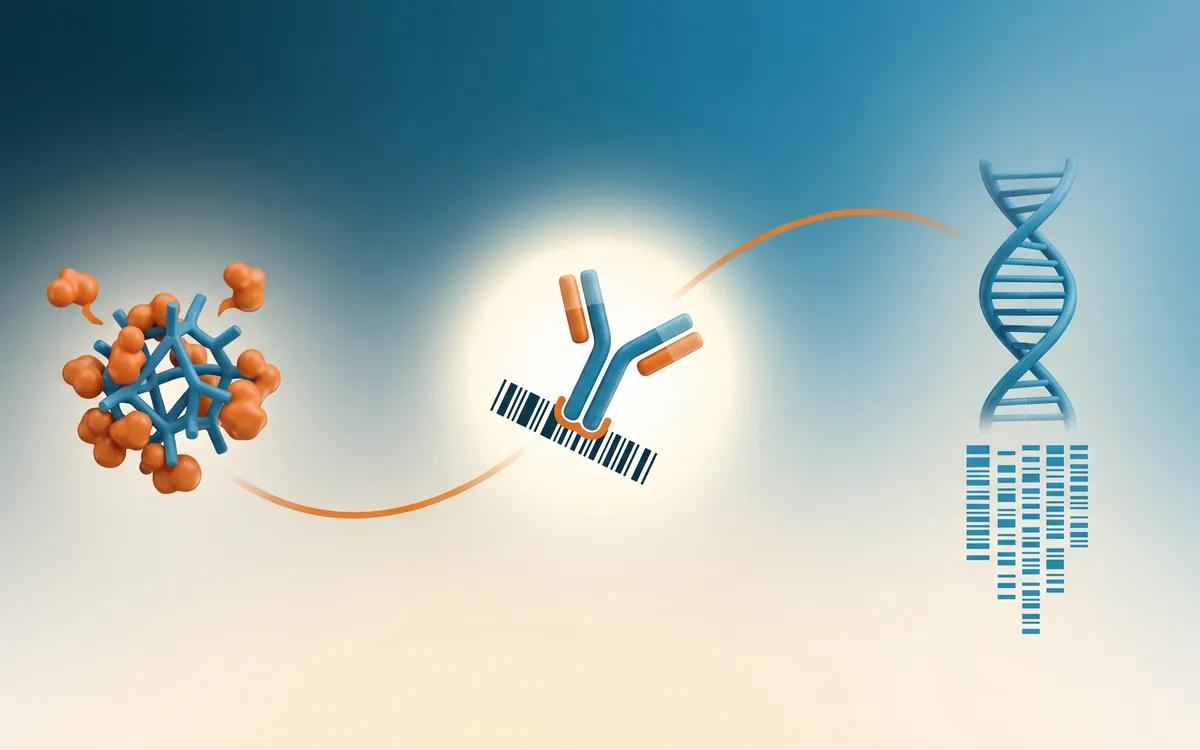
How MIPSA deciphers the antibody reactome: the three-step workflow at a glance.
Read more
A peer-reviewed methodology white paper for VirSIGHT, Infinity Bio's unbiased antibody reactome assay covering 500+ huma…
Read more
Antibody Reactomics: the new dimension for precision immunology research.
Read more
VirSIGHT at a glance: antibody reactome profiling across the known human virome (500+ species).
Read more
Proteome-wide assessment of therapeutic candidate antibodies: comprehensive profiling of on- and off-target binding with…
Read more
A Southern soul ballad about the exposures written into a body’s antibodies, and the EnviroSIGHT panel built to survey t…
Read more
A single unbiased screen against the human proteome recovers the established SLE autoantibody suite and surfaces novel c…
Read more
The molecular record of every infection, exposure, and immune response the body has generated over a lifetime.
Read more
A single unbiased screen across 368,000+ human protein and peptide targets recovers known SLE autoantigens and detects n…
Read more