
Longitudinal phage-display profiling of 403 plasma samples maps HIV antibody breadth from days to years post-seroconversion.
Cell Reports · 2019;27(5):1422–1433.e4 · DOI: 10.1016/j.celrep.2019.03.097
Eshleman SH, Laeyendecker O, Kammers K, et al. Comprehensive profiling of HIV antibody evolution. Cell Rep. 2019;27(5):1422-1433.e4. doi:10.1016/j.celrep.2019.03.097
Eshleman, S. H., Laeyendecker, O., Kammers, K., Chen, A., Sivay, M. V., Kottapalli, S., Sie, B. M., Yuan, T., Monaco, D. R., Mohan, D., Wansley, D., Kula, T., Morrison, C., Elledge, S. J., Brookmeyer, R., Ruczinski, I., & Larman, H. B. (2019). Comprehensive profiling of HIV antibody evolution. Cell Reports, 27(5), 1422-1433.e4. https://doi.org/10.1016/j.celrep.2019.03.097
@article{Eshleman2019HIVAntibodyEvolution,
  author  = {Eshleman, Susan H. and Laeyendecker, Oliver and Kammers, Kai and Chen, Athena and Sivay, Mariya V. and Kottapalli, Sanjay and Sie, Brandon M. and Yuan, Tiezheng and Monaco, Daniel R. and Mohan, Divya and Wansley, Daniel and Kula, Tomasz and Morrison, Charles and Elledge, Stephen J. and Brookmeyer, Ron and Ruczinski, Ingo and Larman, H. Benjamin},
  title   = {Comprehensive Profiling of {HIV} Antibody Evolution},
  journal = {Cell Reports},
  volume  = {27},
  number  = {5},
  pages   = {1422--1433.e4},
  year    = {2019},
  doi     = {10.1016/j.celrep.2019.03.097}
}
Researchers profiled antibody binding to more than 3,300 HIV peptides in 403 plasma samples drawn from 57 women followed across 14 days to 8.7 years after seroconversion, mapping how the anti-HIV antibody repertoire expands, plateaus, and contracts over the course of infection. The cohort included 32 participants who eventually started antiretroviral therapy when their CD4 count fell below 250 cells/mm³, allowing the team to relate antibody-breadth trajectories to clinical course and to pilot a four-peptide serosignature for estimating duration of infection.
In this publication:
HIV-specific antibodies appear within weeks of infection, but how the breadth and fine specificity of those antibodies change over months and years has been hard to map at peptide resolution. This study used a phage-display library called VirScan, presenting more than 3,300 short peptides spanning the entire HIV proteome, to characterize antibody binding in 403 plasma samples from 57 women with subtype C HIV infection. Time from seroconversion to sample collection ranged from 14 days to 8.7 years, allowing the team to follow antibody trajectories through early, mid, and late-stage infection — including in 32 participants who eventually started antiretroviral treatment (ART) when their CD4 cell count fell below 250 cells/mm3.
Antibody breadth — the number of distinct, non-overlapping HIV peptides bound at high levels — rose during the first six months of infection in nearly every participant. In people who did not need to start ART, breadth then plateaued at an individual “antibody breadth set point” that varied considerably between participants. In people who later started ART, breadth instead declined between 9 months and 2 years post-seroconversion — and a faster decline was associated with a shorter time to ART initiation. The authors interpret the decline as a likely consequence of failing T-helper support as CD4 counts fell, with antibody breadth stabilizing at low levels after ART. By contrast, antibody breadth to a prevalent non-HIV virus (Epstein-Barr virus) increased sharply after ART initiation, consistent with broader immune reconstitution.
The team also identified specific peptide-level changes: 266 HIV peptides showed rising antibody reactivity over time, and 43 showed declining reactivity. Drawing from these dynamic peptides, they built a simple, unweighted four-peptide model — one peptide each from gp41, gp120, gag, and pol — that predicted duration of HIV infection more accurately than the LAg-Avidity assay currently used for cross-sectional HIV incidence estimation. The gp41 peptide carrying the strongest single-peptide signal overlapped a sequence already present in the LAg subtype-B target. The authors further showed that targeted “epitope engineering” could sharpen individual peptides’ ability to discriminate early from late infection. Together, the data establish phage-display antibody reactome profiling as a tractable framework for characterizing HIV antibody evolution and surface candidate biomarkers for HIV incidence estimation.
A peer-reviewed methodology white paper for VirSIGHT, Infinity Bio's unbiased antibody reactome assay covering 500+ huma…
Read more
VirSIGHT at a glance: antibody reactome profiling across the known human virome (500+ species).
Read more
The molecular record of every infection, exposure, and immune response the body has generated over a lifetime.
Read more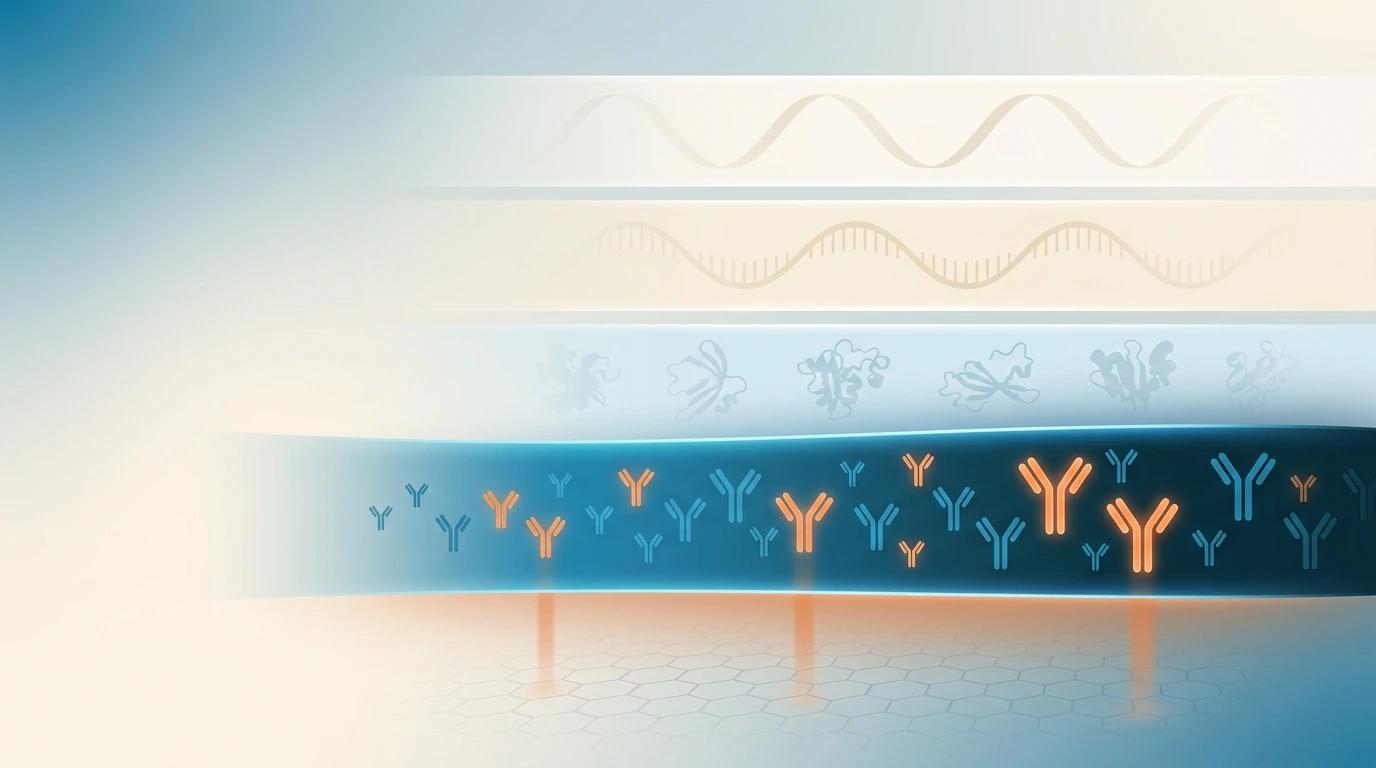
Where the antibody reactome fits in the multi-omic stack, how MIPSA deciphers it, and what the HuSIGHT, VirSIGHT, and En…
Read more
Lindahl et al., 2026: viral immunity in IgG products and global immunity debt.
Read moreAntibody reactome profiling of bat reservoirs identifies emerging zoonotic potential for biosurveillance.
Read moreFrontiers Immunol 2023: pre-infection antibody reactome predicts post-infection HIV viral control.
Read moreAntibody reactome profiling of the human anellome: small DNA viruses persisting in healthy hosts.
Read moreFemales develop broader vaccine-induced antibody repertoires, driven by germinal-center B-cell diversity.
Read moreBjornevik et al., Science 2022: 10M serial serum samples link EBV to multiple sclerosis.
Read moreAntibody epitope selection is partially heritable, shown across twin and SNP-genotyped cohorts.
Read moreBioinformatic deconvolution of cross-reactive signals in virome-wide antibody reactome data.
Read more