
Identify novel SLE autoantigens alongside the ones already reported, in one screen.
Unbiased, reactome-wide autoantigen discovery for your SLE cohort, across 368,000+ human protein and peptide targets.
Scope an SLE pilot
Map all SLE autoantibodies beyond their known targets
Systemic lupus erythematosus (SLE) is defined by a broad and heterogeneous autoantibody response. A positive antinuclear antibody is the obligatory entry criterion for the 2019 EULAR/ACR research classification of SLE.
Aringer et al., Annals of the Rheumatic Diseases, 2019.Clinical and research panels measure a small fraction of that response, and they measure it precisely. Those panels are the right tool for a known target.
The antibody reactome is the full complement of antibody-antigen interactions present in an individual's serum (or plasma) at a given time point. In SLE, the breadth of that reactome remains incompletely characterized. Novel autoantigens linked to disease subsets and severity remain to be identified, along with candidate biomarkers for cohort stratification.
How MIPSA reads the antibody reactome
Antibody Reactomics is the measurement of all antibody reactivities in a sample. MIPSA (Molecular Indexing of Proteins by Self-Assembly) is the technology that deciphers these reactivities, and HuSIGHT is the human MIPSA antigen library. HuSIGHT represents the full human proteome, roughly 20,000 protein-coding genes, as more than 15,000 full-length proteins and more than 353,000 overlapping 90-amino-acid peptide tiles.
Larman and colleagues, Nature Biomedical Engineering, 2022;6(8):992-1003.What the screen adds to SLE autoantigen discovery
Unbiased on two axes
The screen runs the cohort as submitted and reads it against the library as built, with no target list specified in advance. An autoantigen nobody has named yet is in the library already, so it can surface in the result.
Two antigen formats, two classes of epitope
Full-length proteins are folded, so they present conformational epitopes. The peptide tiles map linear epitopes, including the immunodominant regions inside each target.
Built-in validation
Recovering known SLE autoantigens in the same run gives the screen its positive controls. An unnamed hit identified as significantly and differentially detected represents a novel candidate autoantigen.
Robust reproducibility above 0.95
Inter-replicate Pearson correlation is typically above 0.95, so the same sample returns the same reactivities from run to run.
Known targets recovered, novel autoantigens detected in the same run
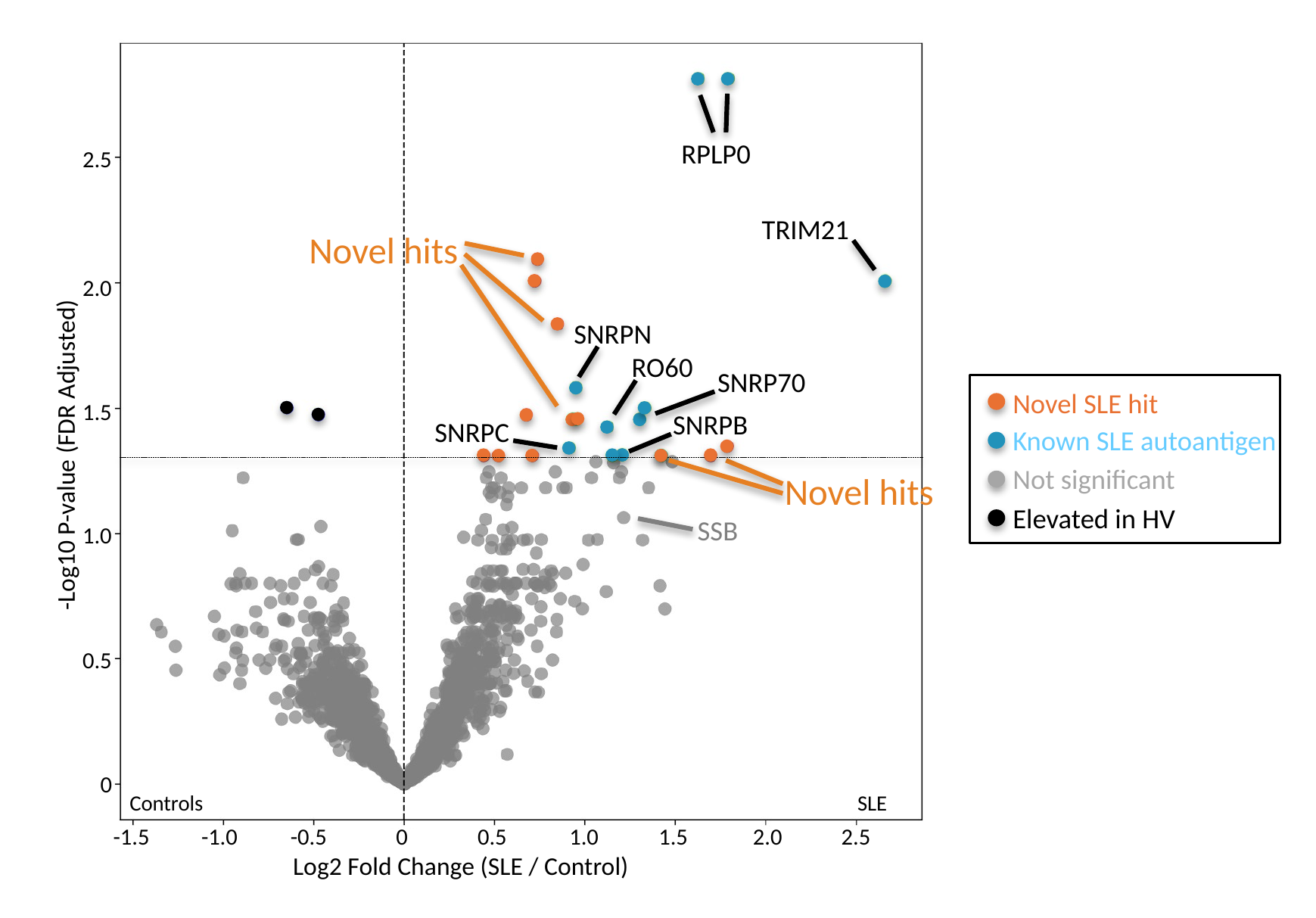
Infinity Bio screened SLE and control serum by MIPSA against the HuSIGHT library, then identified antigens significantly enriched in SLE.
The screen recovered known SLE autoantigens, and also detected novel autoantigens enriched in the SLE cohort. The novel hits showed differential reactivity comparable to the known targets.
- Ro60/SSA
- Sm (SNRPB/C/N)
- U1-RNP (SNRP70)
- Ro52/TRIM21
- ribosomal P (RPLP0)
Inputs and turnaround
- Sample
- Serum, microliter-scale
- Archived samples
- Banked serum works
- Turnaround
- 6 to 8 weeks
- Libraries
- Combinable in one assay
Read further
-
The MIPSA method paper
Larman and colleagues, Nature Biomedical Engineering, 2022;6(8):992-1003.
Add Antibody Reactomics to your next discovery cohort.
The next big discovery is sitting in a freezer right now. If a lupus cohort is banked and its autoantibody profile is uncharacterized, one screen can return previously reported specificities and novel candidates together. Your next discovery awaits.
Scope an SLE pilotFor Research Use Only. Not for use in diagnostic procedures.