
1,003 adults profiled across 58,233 phage-displayed allergen peptides reveal a five-year-stable IgG fingerprint of dietary history.
Immunity · December 13, 2022 · DOI: 10.1016/j.immuni.2022.11.004
Leviatan S, Vogl T, Klompus S, Kalka IN, Weinberger A, Segal E. Allergenic food protein consumption is associated with systemic IgG antibody responses in non-allergic individuals. Immunity. 2022;55(12):2454-2469.e6. doi:10.1016/j.immuni.2022.11.004
Leviatan, S., Vogl, T., Klompus, S., Kalka, I. N., Weinberger, A., & Segal, E. (2022). Allergenic food protein consumption is associated with systemic IgG antibody responses in non-allergic individuals. Immunity, 55(12), 2454–2469.e6. https://doi.org/10.1016/j.immuni.2022.11.004
@article{leviatan2022allergenic,
  title   = {Allergenic food protein consumption is associated with systemic IgG antibody responses in non-allergic individuals},
  author  = {Leviatan, Sigal and Vogl, Thomas and Klompus, Shelley and Kalka, Iris N. and Weinberger, Adina and Segal, Eran},
  journal = {Immunity},
  volume  = {55},
  number  = {12},
  pages   = {2454--2469.e6},
  year    = {2022},
  doi     = {10.1016/j.immuni.2022.11.004}
}
Leviatan and colleagues used PhIP-Seq to measure systemic IgG binding against tens of thousands of food and environmental allergen peptides in a population-scale Israeli cohort. They found that common food antigens elicit measurable systemic IgG in up to half of non-allergic adults — far above clinical allergy prevalence — and that those antibody repertoires correlate with dietary intake. In a five-year longitudinal subcohort, the IgG epitope pattern was highly correlated within individuals but not between random pairs, behaving as a durable molecular fingerprint of an individual's diet.
In this publication:
This study repositions food-directed IgG from a presumed pathology signal to a quiet, baseline immunological record of consumption. Using PhIP-Seq (phage immunoprecipitation sequencing), the authors profiled IgG binding against 58,233 peptides drawn from food and environmental allergen databases in 1,003 Israeli adults — 58 million antibody–peptide interactions in total — and detected, on average, 322 ± 106 peptides significantly enriched per person.
Hierarchical clustering surfaced 13 antibody-binding clusters spanning food and environmental antigens, with extensive cross-reactivity across phylogenetically related cereals, milk proteins, poultry, and legumes. Parallel IgG- and IgA-specific capture experiments confirmed the binding signal is overwhelmingly IgG. In a 214-individual longitudinal subcohort sampled five years apart, food-directed IgG epitope repertoires were highly correlated within individuals but not between random pairs — functioning as a five-year-stable molecular fingerprint of dietary history.
For allergists separating clinically meaningful IgE-mediated sensitization from background reactivity, the work quantifies the non-allergic IgG baseline that any food-allergy biomarker must be measured against. For nutrition and microbiome researchers, it offers a serological lens on the diet–immune axis that can be triangulated with diet diaries, anthropometrics, and microbiome composition in the same cohort.
Why reactome profiling captures biology that other immune assays miss.
Read more
Ben Larman at AIRRC7: the science behind MIPSA library construction.
Read more
Why reactome profiling captures biology that other immune assays miss.
Read more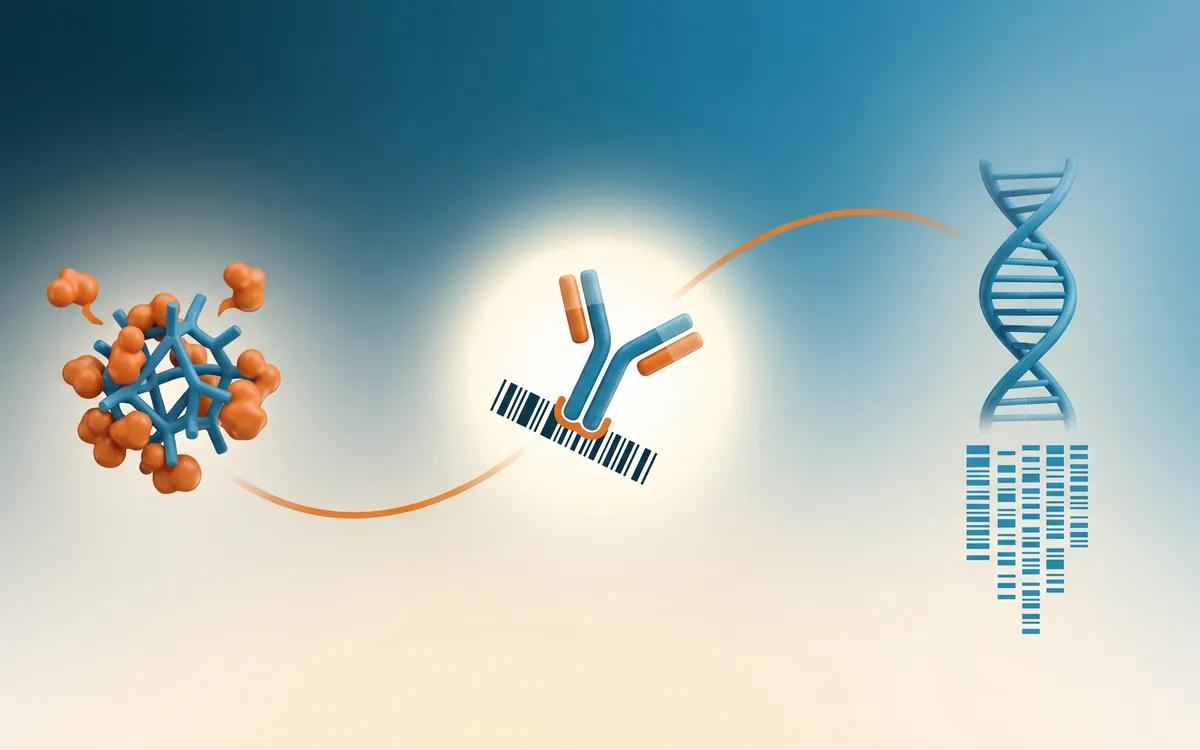
How MIPSA deciphers the antibody reactome: the three-step workflow at a glance.
Read more
Antibody Reactomics: the new dimension for precision immunology research.
Read more
Where the antibody reactome fits in the multi-omic stack, how MIPSA deciphers it, and what the HuSIGHT, VirSIGHT, and En…
Read more
Ben Larman on translating dense reactome data: Antibody Reactomics framework, Complex Data Delivery.
Read more
Dolphyn algorithm: efficient epitope prioritization for extensive antigenic spaces.
Read moreSchistosoma mansoni vaccine candidates identified via unbiased screening in self-cured macaques.
Read moreMethods paper: statistical detection of true antibody reactivities in sequencing-based reactome data.
Read moreCredle et al., Nature Comm 2022: the foundational MIPSA paper introducing antibody reactome profiling.
Read moreBioinformatic deconvolution of cross-reactive signals in virome-wide antibody reactome data.
Read more