
A purpose-built Bayesian framework (BEER) lifts PhIP-Seq sensitivity in the moderate-fold-change regime where weak-but-real antibody reactivities live.
BMC Genomics · 2022;23:654 · DOI: 10.1186/s12864-022-08869-y
Chen A, Kammers K, Larman HB, Scharpf RB, Ruczinski I. Detecting antibody reactivities in Phage ImmunoPrecipitation Sequencing data. BMC Genomics. 2022;23:654. doi:10.1186/s12864-022-08869-y
Chen, A., Kammers, K., Larman, H. B., Scharpf, R. B., & Ruczinski, I. (2022). Detecting antibody reactivities in Phage ImmunoPrecipitation Sequencing data. BMC Genomics, 23, 654. https://doi.org/10.1186/s12864-022-08869-y
@article{chen2022phipseq,
  author    = {Chen, Athena and Kammers, Kai and Larman, H. Benjamin and Scharpf, Robert B. and Ruczinski, Ingo},
  title     = {Detecting antibody reactivities in {Phage ImmunoPrecipitation Sequencing} data},
  journal   = {BMC Genomics},
  volume    = {23},
  pages     = {654},
  year      = {2022},
  doi       = {10.1186/s12864-022-08869-y},
  pmid      = {36109689},
  pmcid     = {PMC9476399}
}
A Johns Hopkins methods paper that asks a deceptively simple question: do off-the-shelf RNA-Seq tools handle PhIP-Seq antibody reactivity data correctly? The authors find that edgeR is remarkably effective on PhIP-Seq read-count matrices, then introduce BEER (Bayesian Enrichment Estimation in R) — a framework purpose-built for the “n mock IPs versus 1 sample” design that defines PhIP-Seq experiments. BEER raises sensitivity for moderately enriched peptides without inflating false positives.
In this publication:
PhIP-Seq (Phage ImmunoPrecipitation Sequencing) lets researchers measure which of hundreds of thousands of candidate peptides a person’s antibodies bind to — producing a read-count matrix that, on the surface, looks much like RNA-Seq output. Because of that resemblance, many labs have repurposed RNA-Seq analysis tools (edgeR, DESeq2, voom) for PhIP-Seq. But the underlying biology and experimental design are different: PhIP-Seq compares one serum sample against a small panel of antibody-free “mock IP” (beads-only) wells, and low-count peptides may carry real biological signal rather than being filterable noise.
The authors first stress-test edgeR on PhIP-Seq data and find it works surprisingly well, capturing the dominant variance structure even though it was designed for two-group RNA-Seq comparisons. They then introduce BEER (Bayesian Enrichment Estimation in R), a framework explicitly built around PhIP-Seq’s data-generating mechanism: a Bayesian model that uses edgeR’s parameter estimates as informative priors, then computes per-peptide posterior probabilities of enrichment. Across simulations and two real datasets — HIV elite controllers and SARS-CoV-2 convalescent samples — BEER delivers higher sensitivity for moderately enriched peptides while keeping false positives tightly controlled.
Translation for working immunologists: if your VirScan or AllerScan analysis pipeline pivots on edgeR, the results are likely defensible — but you are leaving discoveries on the table at intermediate fold-changes, exactly the regime where weak but biologically meaningful antibody reactivities live. BEER recovers them at the cost of additional CPU time for MCMC sampling, and is distributed via Bioconductor with the full pipeline at github.com/athchen/beer_manuscript.
Why reactome profiling captures biology that other immune assays miss.
Read more
Ben Larman at AIRRC7: the science behind MIPSA library construction.
Read more
Why reactome profiling captures biology that other immune assays miss.
Read more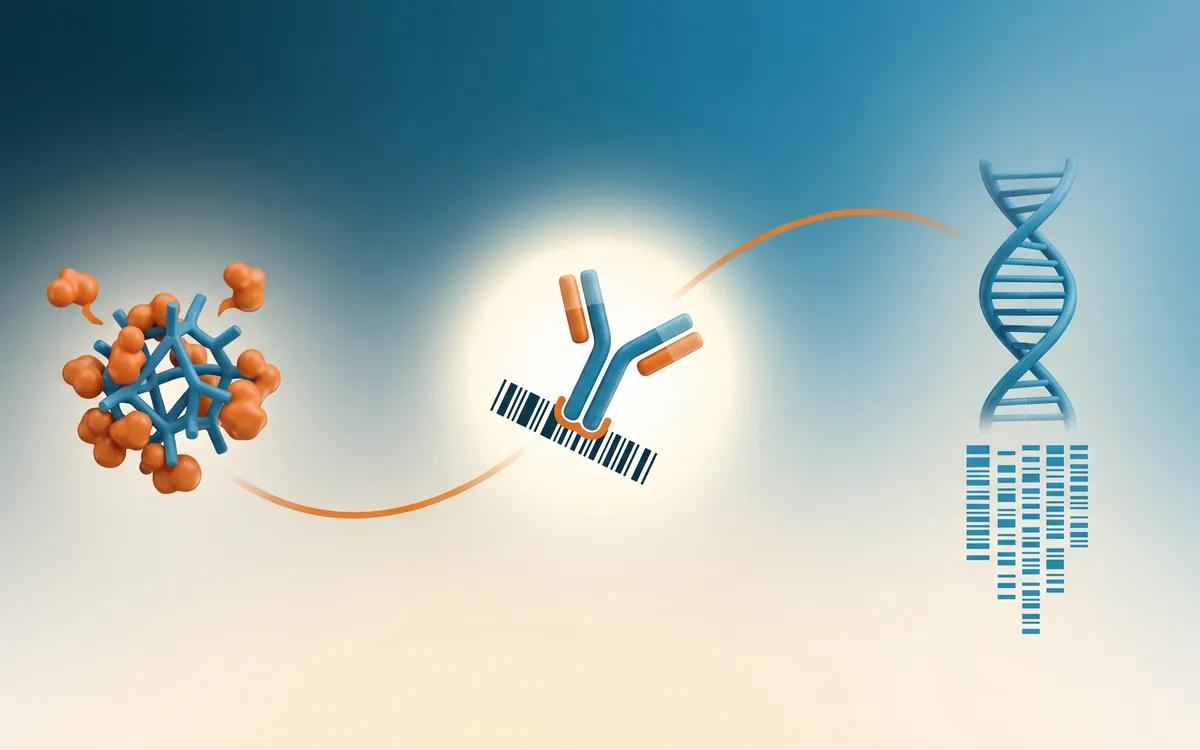
How MIPSA deciphers the antibody reactome: the three-step workflow at a glance.
Read more
Antibody Reactomics: the new dimension for precision immunology research.
Read more
Proteome-wide assessment of therapeutic candidate antibodies: comprehensive profiling of on- and off-target binding with…
Read more
A Southern soul ballad about the exposures written into a body’s antibodies, and the EnviroSIGHT panel built to survey t…
Read more
A single unbiased screen against the human proteome recovers the established SLE autoantibody suite and surfaces novel c…
Read more
The molecular record of every infection, exposure, and immune response the body has generated over a lifetime.
Read more
A single unbiased screen across 368,000+ human protein and peptide targets recovers known SLE autoantigens and detects n…
Read more
Where the antibody reactome fits in the multi-omic stack, how MIPSA deciphers it, and what the HuSIGHT, VirSIGHT, and En…
Read more
Ben Larman on translating dense reactome data: Antibody Reactomics framework, Complex Data Delivery.
Read more