
Single-amino-acid-resolution mapping of peanut-specific IgE and IgG epitopes in 15 children undergoing oral immunotherapy.
Cell Reports Medicine · October 19, 2021 · DOI: 10.1016/j.xcrm.2021.100410
Chen G, Shrock EL, Li MZ, et al. High-resolution epitope mapping by AllerScan reveals relationships between IgE and IgG repertoires during peanut oral immunotherapy. Cell Rep Med. 2021;2(10):100410. doi:10.1016/j.xcrm.2021.100410
Chen, G., Shrock, E. L., Li, M. Z., Spergel, J. M., Nadeau, K. C., Pongracic, J. A., Umetsu, D. T., Rachid, R., MacGinnitie, A. J., Phipatanakul, W., Schneider, L., Oettgen, H. C., & Elledge, S. J. (2021). High-resolution epitope mapping by AllerScan reveals relationships between IgE and IgG repertoires during peanut oral immunotherapy. Cell Reports Medicine, 2(10), 100410. https://doi.org/10.1016/j.xcrm.2021.100410
@article{chen2021allerscan,
  title   = {High-resolution epitope mapping by AllerScan reveals relationships between IgE and IgG repertoires during peanut oral immunotherapy},
  author  = {Chen, Genghao and Shrock, Ellen L. and Li, Mamie Z. and Spergel, Jonathan M. and Nadeau, Kari C. and Pongracic, Jacqueline A. and Umetsu, Dale T. and Rachid, Rima and MacGinnitie, Andrew J. and Phipatanakul, Wanda and Schneider, Lynda and Oettgen, Hans C. and Elledge, Stephen J.},
  journal = {Cell Reports Medicine},
  volume  = {2},
  number  = {10},
  pages   = {100410},
  year    = {2021},
  doi     = {10.1016/j.xcrm.2021.100410}
}
Peanut oral immunotherapy (OIT) is one of the only therapies that can desensitize peanut-allergic patients, yet what actually happens to a patient’s antibody repertoire during treatment had been hard to see at residue-level resolution. The Larman and Elledge labs introduce AllerScan — a phage-display plus next-generation sequencing platform that maps peanut-specific IgE and IgG epitopes across all 12 WHO/IUIS-listed peanut allergens at single-amino-acid resolution — and apply it to 15 peanut-allergic children enrolled in the PRROTECT clinical trial.
In this publication:
Peanut allergy affects roughly 2.2% of children and 1.8% of adults in the United States and can cause life-threatening anaphylaxis. The dominant mechanism is IgE antibodies that recognize specific peanut proteins; when those antibodies bind allergen, they trigger mast cells and basophils to release histamine and related mediators. Oral immunotherapy (OIT) — the gradual administration of escalating doses of allergen — is one of the only treatments that can desensitize allergic patients, but exactly which IgE epitopes go down and which IgG epitopes come up during therapy has been hard to see at residue resolution.
To address that gap, the authors built AllerScan, a phage-display library of 397 overlapping 20-mer peptides that tile every 10 amino acids across all 12 peanut allergens listed in the WHO/IUIS Allergen Nomenclature database. To push the resolution further, they added saturation-mutagenesis variants — replacing each residue with every other amino acid — so that IgE and IgG binding could be mapped down to individual amino acid positions. They applied AllerScan to serum from 15 peanut-allergic children enrolled in the PRROTECT clinical trial before and after a course of peanut OIT.
The picture that emerged was not a uniform “antibodies go down” story. After OIT, the peanut-specific IgG repertoire diversified and increased in magnitude, while pre-existing IgE levels against individual epitopes decreased. Across patients, certain “public” epitopes in the major allergens Ara h 1, 2, 3, and 7 were recognized in common. Within individual subjects, OIT-induced IgG specificities overlapped extensively with the patient’s IgE specificities and exhibited strikingly similar antibody footprints, suggesting related clonal lineages or convergent evolution of peanut-specific IgE and IgG B cells. The residue-level granularity opens a path toward safer, personalized OIT regimens guided by each patient’s epitope-specific antibody repertoire.
Why reactome profiling captures biology that other immune assays miss.
Read more
Ben Larman at AIRRC7: the science behind MIPSA library construction.
Read more
Why reactome profiling captures biology that other immune assays miss.
Read more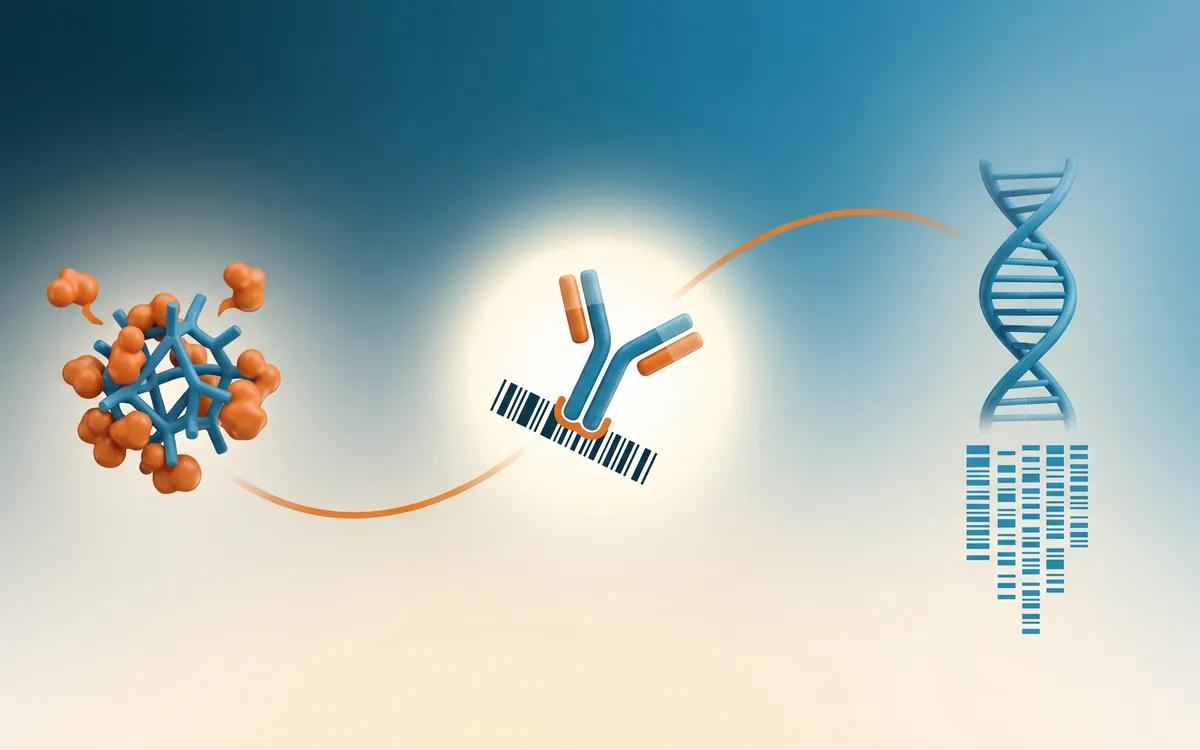
How MIPSA deciphers the antibody reactome: the three-step workflow at a glance.
Read more
Antibody Reactomics: the new dimension for precision immunology research.
Read more
Proteome-wide assessment of therapeutic candidate antibodies: comprehensive profiling of on- and off-target binding with…
Read more
A Southern soul ballad about the exposures written into a body’s antibodies, and the EnviroSIGHT panel built to survey t…
Read more
A single unbiased screen against the human proteome recovers the established SLE autoantibody suite and surfaces novel c…
Read more
The molecular record of every infection, exposure, and immune response the body has generated over a lifetime.
Read more
A single unbiased screen across 368,000+ human protein and peptide targets recovers known SLE autoantigens and detects n…
Read more
Where the antibody reactome fits in the multi-omic stack, how MIPSA deciphers it, and what the HuSIGHT, VirSIGHT, and En…
Read more
Ben Larman on translating dense reactome data: Antibody Reactomics framework, Complex Data Delivery.
Read more